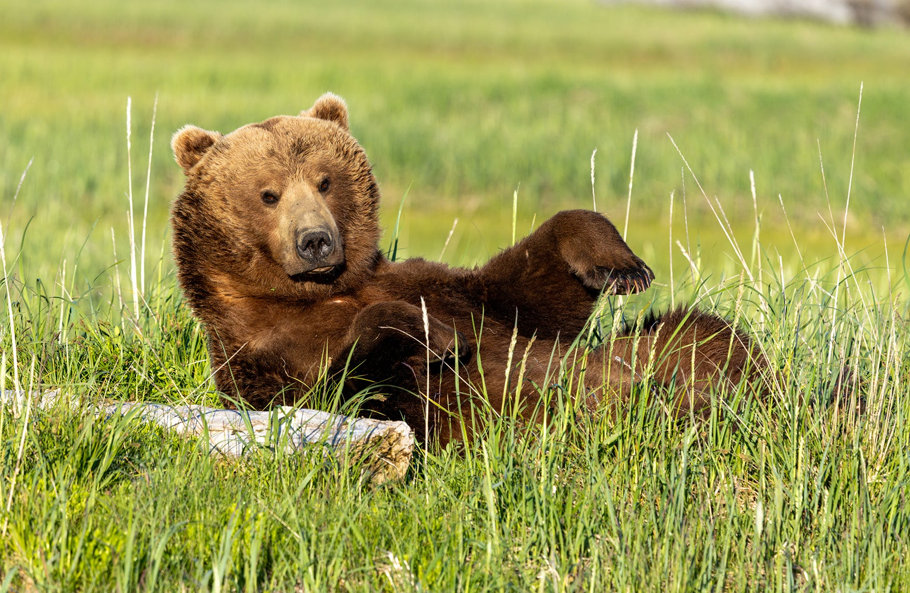
On October 19th, the Trump Administration finalized a rule allowing hunters to use bait, such as doughnuts and bacon grease, to lure and kill bears on national preserves in Alaska. CRS strongly condemns this new policy as antithetical to the purposes of protecting these areas, calling the rule immoral and an affront to the fair chase principles that guide legitimate hunting. “There appears to be no bottom to how low this administration will stoop to exploit America’s natural treasures. Bear baiting is not hunting. It allows unscrupulous, lazy ass people who are too wimpy to actually hunt, to execute bears in a nationally protected area. It is an anathema to actual hunting,” said CRS President David Jenkins. “This is no doubt another effort by the Trump Administration to cater to super wealthy trophy ‘hunter’ pals who can’t be bothered to actually hunt. Bears are magnificent animals, and baiting them is particularly cruel because their God-given drive to eat is supposed to help them survive through the winter,” Jenkins added. Conservatives for Responsible Stewardship (CRS) CRS is a national nonprofit grassroots organization founded on the premise that environmental stewardship and natural resource conservation are inherently conservative, and that true conservatives endeavor to be good stewards of the natural systems and resources that sustain life on earth. Learn more about CRS at the organization’s website: https://www.conservativestewards.org...
CRS President David Jenkins was interviewed on the Bill Meyer radio show in Oregon about the Trump Administration’s proposal to scrap the 25-year-old Roadless Area Protection Rule. In the interview, Jenkins spars with Meyer and explains why the repeal would be a really bad deal for American taxpayers and will only exacerbate our wildfire risk. Watch key clips from the interview here. For the full 20-minute interview, listen to it here. You can also submit comments opposing the planned Roadless Rule rollback at the CRS Action...
By Mark Moran Advocates in Alaska’s Interior warned a proposed gold mine on the Johnson Tract in Lake Clark National Park threatens critical habitat ecosystems and a large chunk of the state’s economy. Contango Silver and Gold Mining Inc. said it will be sensitive to the environment while creating jobs. Contango is working with Alaska Native-owned Cook Inlet Region Inc. to establish the mine at the headwaters of the Johnson River, a prime spot for commercial and sportfishing, bear watching, salmon runs and ecotourism. David Jenkins, president of Conservatives for Responsible Stewardship, contended the environmental risk is not worth the economic reward, especially when the bulk of the profit from the mine flows to out-of-state investors, including asset management companies like BlackRock and Vanguard. “Why would you risk a 100% Alaskan economic engine that’s sustainable and just keeps providing benefits year after year for something that’s temporary, and most of the economic benefit is likely to go elsewhere outside of the state of Alaska?” Jenkins asked. Read the full...
By David Jenkins and Oliver Coray Up until now, this state has done a commendable job of maintaining a diverse economy, balancing the needs of its various economic engines and nimbly avoiding a common economic trap known as the “resource curse.” The resource curse is a phenomenon where the extraction of an area’s natural resources, such as oil, gas and minerals, results in economic decline rather than increased prosperity. This curse comes in various forms and has been documented all over the world. Here in the United States, West Virginia is a prime example, which Business Insider recently ranked as having the nation’s worst economy. Alaska has largely avoided the curse because much of its resource extraction activity has not been in direct conflict with other key economic engines, such as commercial fishing and tourism. This has helped the state maintain the sector diversity needed to sustain a healthy economy. Unfortunately, the state is flirting with projects that threaten to upset that balance and permanently damage Alaska’s economy: the infamous proposed Pebble gold mine in the Bristol Bay watershed and the lesser-known Johnson Tract mine in Lake Clark National Park. Read the entire...
By John Loftus, Editor at Large Conservative conservation groups are warning against a Trump administration proposal to give away a piece of Yosemite National Park in California’s Sierra Nevada mountains to a private developer. National Park Service (NPS) staff in California and Washington, D.C., have been trying to arrange a Yosemite land exchange between the federal government and a Nevada-based developer since the spring of 2025, NOTUS reported Aug. 28. But two conservative conservation groups, Conservatives for Responsible Stewardship (CRS) and the American Conservation Coalition (ACC), are pushing back against the proposal, which they believe does not serve the public interest and reverses longtime precedent. “This move by the administration is quite unprecedented, and I fear it is a harbinger of additional efforts to give away our iconic natural treasures,” David Jenkins, president of CRS, told the Daily Caller. “While land exchanges are quite common, they occur when doing so offers a clear benefit to the park and is in the public interest. This is different; it appears to be for the sole benefit of a private interest.” Read the full...